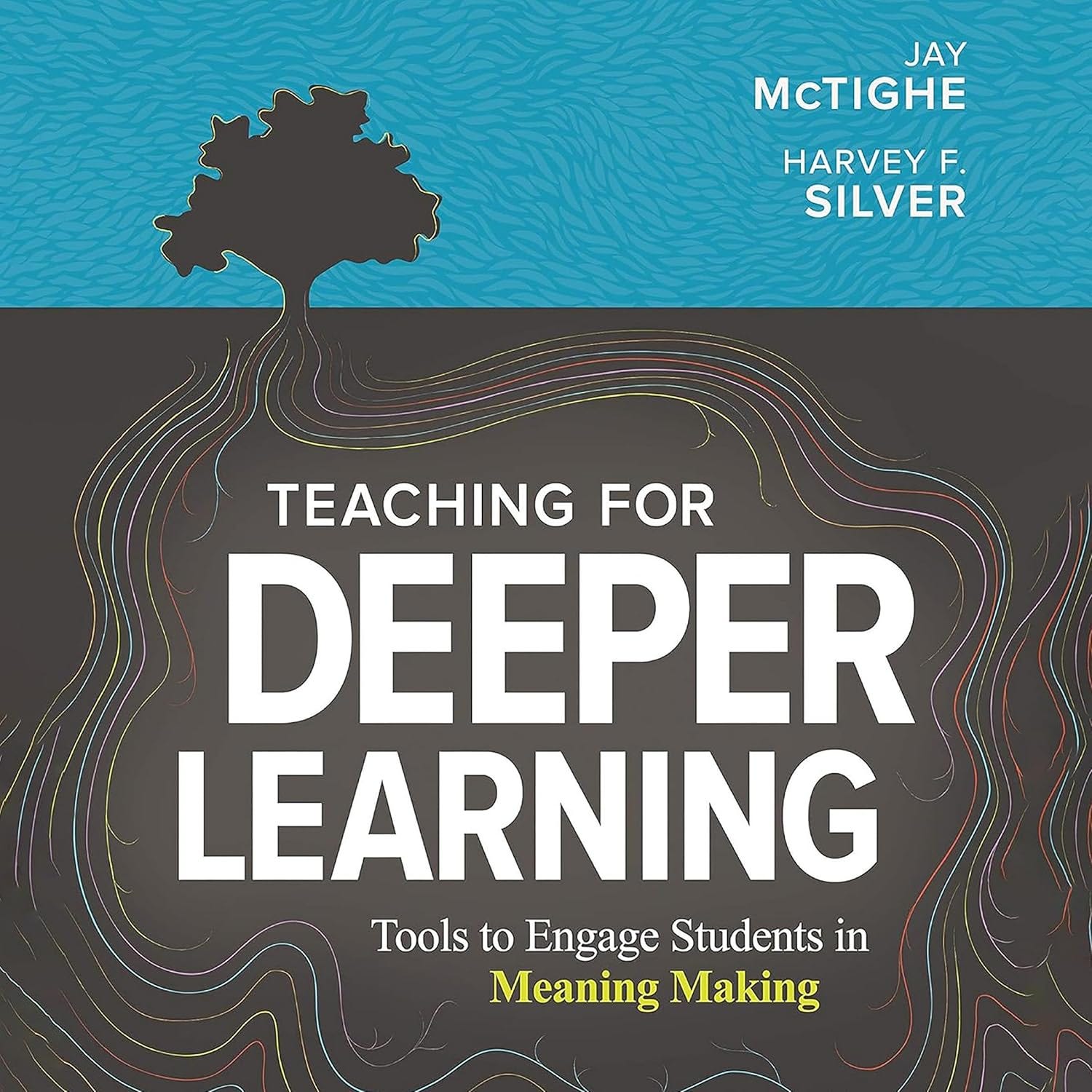
Teaching for Deeper Learning: Tools to Engage Students in Meaning Making
Jay McTighe & Harvey F. Silver (2020) | ASCD
PART 1: SECTION-BY-SECTION LOGICAL MAPPING
PREFACE
Core Claim: The book achieves Buckminster Fuller’s four design criteria: purpose, functionality, user approval, and beauty (defined as “simple and deep”).
Supporting Evidence:
Purpose: shift from knowledge consumption to meaning-making
Functionality: “tested and refined” in workshops and coaching
User approval: “extremely positive and enthusiastic” feedback from educators
Beauty: tools are simple in form, designed to create deep change
Logical Gaps:
“Extremely positive and enthusiastic” feedback is not quantified. No sample size, no comparison condition, no measure of what changed in classrooms. This is testimonial, not evidence.
“Simple and deep” is asserted as the design standard but the preface does not specify what would count as failure to meet it. The criterion is unfalsifiable as stated.
Methodological Soundness: The preface establishes aspirational framing, not empirical claims. It should be read as a statement of intent, not proof of achievement.
INTRODUCTION
Core Claim: Deep learning requires active meaning-making through seven specific thinking skills, which are simultaneously under-taught and high-impact.
Supporting Evidence:
National Research Council (2000) cited for the concept of “inert knowledge”—learning superficially acquired and promptly forgotten
Seven skills identified: conceptualizing, notemaking/summarizing, comparing, reading for understanding, predicting/hypothesizing, visualizing/graphic representation, perspective taking/empathizing
Claims made about the skills: they embody “essentials of good thinking,” are embedded in academic standards, separate high achievers from low performers, and are rarely directly taught
Logical Method: Motivating argument by contrast: inert knowledge (bad) vs. deep understanding (good), with the seven skills positioned as the mechanism bridging the gap.
Logical Gaps:
The claim that these seven skills “separate high achievers from their average or low performing peers” is asserted without citation. This is a causal claim (skills cause achievement differences) dressed as a correlation claim, without either being documented.
“Under-taught considering how vital these skills are” is a normative assertion that presupposes the vitality claim is established. It is not—it is the conclusion the book is trying to prove.
The selection of exactly seven skills is justified as “manageable” rather than principled. No argument is made that these seven are exhaustive, necessary, or sufficient. Other candidates (e.g., argumentation, self-regulation, metacognition) are not addressed.
“Seven is a manageable number” is a pedagogical convenience claim, not a logical one. The number of skills to teach should follow from what skills exist, not from what is easy to remember.
Methodological Soundness: The introduction frames a credible problem (inert vs. deep learning) but the solution—these specific seven skills—is asserted rather than derived. The logical gap between “students need to think more deeply” and “these seven tools produce that” is the book’s central unproven premise.
CHAPTER 1: Framing Learning Around Big Ideas
Core Claim: Modern curricula should prioritize a smaller number of conceptually larger, transferable ideas rather than broad coverage of discrete facts.
Supporting Evidence:
Knowledge base expanding faster than it can be absorbed (general claim, no source)
Four rationales for big-idea focus:
Too much information to cover
Coverage produces superficial learning; depth enables transfer
Expert knowledge is organized around core concepts, not fact lists (National Research Council, 2000, p. 36)
Transfer requires conceptual understanding, not rote knowledge
Common Core State Standards, NGSS, and C3 Framework cited as endorsing this approach
Three tools presented: A Study In, Concept Word Wall, Essential Questions
Logical Method: Argument from cognitive science (how experts organize knowledge) + argument from standards alignment + argument from world-change (unpredictability demands transferable learning).
Logical Gaps:
The NRC citation about expert knowledge organization is used to justify teaching students to think like experts. This inference requires that novice-to-expert transitions are primarily driven by conceptual framing rather than domain knowledge accumulation—a contested claim in expertise research that the authors do not acknowledge.
“Concept Word Wall reminds teachers to identify key concepts” is a procedural recommendation without evidence that visual display of concepts in classrooms changes learning outcomes. The tool is presented as self-evidently useful.
Essential questions are presented with examples but without evidence that framing curriculum around open questions produces better learning outcomes than other curriculum design approaches. Wiggins (1989) is cited but the citation is for a general claim about education’s purpose, not for EQ effectiveness.
The “A Study In” tool example: framing Impressionism as “a study in revolution” rather than “a study in icebergs” for the Titanic is given as obvious evidence that conceptual framing produces deeper thinking. This is illustrative, not evidential.
Methodological Soundness: The big-idea argument is well-supported at the theoretical level by cognitive science on expertise. The specific tools (Concept Word Wall, EQs, A Study In) are presented with craft examples and anecdote, not outcome data. The gap between “conceptual curricula are better in theory” and “these specific tools produce that better outcome” is not closed.
CHAPTER 2: Conceptualizing
Core Claim: Students can be taught to construct conceptual understandings from examples, rather than receiving definitions passively, through five specific tools.
Supporting Evidence:
Jerome Bruner (1973) cited as foundation for Concept Attainment’s inductive approach
Claim that defining concepts for students produces less understanding than student-constructed definitions
Five tools: Concept Attainment, Concept Definition Map, A Study In (student version), Adding Up the Facts, Connect the Concepts
Concept Attainment detailed with a step-by-step predator/prey example
Logical Method: Inductive pedagogy rationale: present examples → students extract attributes → students construct definitions → understanding is deeper than passive reception.
Logical Gaps:
“Defining concepts for students doesn’t lead to the same level of understanding as when students construct definitions for themselves” is stated as established fact. No citation is provided for this specific claim, though it is broadly consistent with constructivist learning theory. The absence of citation for a foundational claim is notable.
The Concept Attainment sequence is logical and clearly presented, but the worked example (predator) is used to demonstrate how the tool works, not whether it works better than alternatives. The tool’s logic is sound; its comparative effectiveness is undemonstrated.
“Connect the Concepts” tool: the claim that connecting concepts to form generalizations produces transfer is well-grounded theoretically (Erickson, Stern cited), but the tool itself—having students write relationship sentences—is not distinguished from other generalization activities by evidence.
The BlackBerry example (failure to adapt to iOS/Android) is used to illustrate that the adaptation→survival generalization transfers beyond biology. This is a conceptual illustration, not evidence of transfer produced by the tool.
Methodological Soundness: Chapter 2 has the strongest theoretical grounding in the book. Bruner’s concept attainment work is genuine empirical research. The tools themselves extend that research logically but without independent validation studies.
CHAPTER 3: Notemaking and Summarizing
Core Claim: Note-making (active construction) is superior to note-taking (passive copying), and summarizing requires direct instruction because students lack the skill to distinguish essential from non-essential information.
Supporting Evidence:
Meta-analytic citations: Beasley & Abthorpe (2010); Boyle (2013); Guido & Colwell (1987); Ramani & Sadegi (2011)—both skills have “positive effects on student learning at all grade levels and content areas”
Six tools: Window Notes, Math Notes, Interactive Note-Making (based on SQ3R), Webbing, Four-to-One Summarize, Awesome Summaries
SQ3R (Robinson, 1946) cited as foundation for Interactive Note-Making
Pressley (2006) cited for three-phase reading model (before, during, after)
Logical Method: Problem identification (students copy rather than construct) → tool design (force active processing) → cite meta-analytic support for the general skill category.
Logical Gaps:
The meta-analytic support cited is for “notemaking and summarizing” as skill categories—not for these specific tools. The tools are implementations of the underlying skills, but their effectiveness relative to other implementations is not established.
Window Notes’ four-quadrant structure (facts, questions, connections, feelings/reactions) is presented as producing deeper engagement without evidence that the feelings/reactions quadrant specifically contributes to learning over the facts-only approach it replaces.
Math Notes is presented as valuable for word problems, but no data on student performance using Math Notes vs. standard problem-solving approaches is provided. The logical argument for the tool (slow students down, force problem analysis before solving) is sound; the outcome evidence is absent.
“Awesome Summaries” (acronym: AWESOME) provides a checklist without evidence that checklist-based summary evaluation produces better summaries than direct instruction in summary criteria.
Methodological Soundness: This chapter has stronger citation backing than most because the general research on summarizing and note-making is substantial. The specific tools inherit that backing by logical extension but are not independently validated.
CHAPTER 4: Comparing
Core Claim: Comparing is both a natural cognitive capacity and one of the highest-impact instructional strategies, but common classroom implementation fails because of identifiable, correctable problems of practice.
Supporting Evidence:
Meta-analytic citations: Dean et al. (2012); Marzano, Pickering & Pollock (2001)—”significant gains in achievement” from teaching comparison and contrast
Tiantoni & Hu (2016) cited for comparison’s role in transfer: “transfer is more likely to occur if students are taught how to detect similarities and differences”
Six tools addressing six specific problems of practice
Problems identified with specificity: rushing to compare without describing first, trivial criteria, ineffective organizers (Venn diagram critique), no conclusion drawn, no transfer to discussion
Logical Method: Meta-analytic support → problem taxonomy → tool-per-problem mapping. This is the most systematically structured chapter in the sampled material.
Logical Gaps:
The Venn diagram critique (”not enough room,” “middle separates the differences”) is a usability argument, not a learning outcomes argument. The claim that T-chart or comparison matrix produces better learning than Venn diagrams is not supported by comparative evidence.
The “Describe First, Compare Second” tool recommendation is logically sound (understand before comparing) but the specific three-column format is not distinguished from other pre-comparison activities by evidence.
Community Circle uses the CIRCLE acronym for discussion management. The evidence base for this specific tool is not cited; it is presented as a logical extension of comparison into discussion format.
“What Can You Conclude?” is the chapter’s most intellectually important tool—moving students from enumeration to synthesis—but it is the least developed. The examples given are good (who makes a more compelling argument, Washington or DuBois?), but no evidence is provided that prompting for conclusions produces generalizations that students actually retain and transfer.
Methodological Soundness: Chapter 4 has the strongest citation base in the sampled chapters. The meta-analytic evidence for comparison as an instructional strategy is real and well-documented. The specific tools are logically derived from the research but not independently validated.
CHAPTER 5: Reading for Understanding
Core Claim: Proficient reading involves three distinct phases (before, during, after), and all students can be taught proficient reader behaviors through explicit tool-based instruction.
Supporting Evidence:
Pressley (2006) cited for three-phase model of proficient reading
Five tools: Power Previewing, Scavenger Hunt, Single Sentence Summaries, Reading Stances (Langer, 1994), Reading for Meaning (Silver, Morris & Klein, 2010)
Reading Stances grounded in Langer (1994)—four stances: literal, interpretive, personal, critical
Logical Method: Expert-novice gap (proficient readers do X; struggling readers don’t) → teach X explicitly → all students become more proficient.
Logical Gaps:
The expert-novice gap logic is borrowed from cognitive science but requires that the behaviors of proficient readers are causes of proficiency rather than correlates of it. A student who already understands a text will preview more effectively—the causal direction is not established.
Power Previewing’s “Five P’s” (Probe, Pencil, Pry, Personalize, Predict) are a mnemonic device for behaviors that may or may not have the same effect when applied by struggling readers as when observed in proficient ones. No evidence is cited that teaching the Five P’s to struggling readers produces the comprehension gains attributed to previewing in proficient readers.
Scavenger Hunt’s engagement mechanism (game format, active search) is logically coherent but without comparative evidence against direct comprehension instruction.
Reading Stances (Langer, 1994) has a legitimate research foundation. But the four-stance framework in this book (literal, interpretive, personal, critical) is a simplification of Langer’s more complex stance theory. Whether the simplification preserves the instructional benefits is not addressed.
Reading for Meaning is presented as “comprehensive” and “works especially well with shorter texts.” The “especially well” qualifier is undefended—no evidence is provided for which text types or student populations benefit most.
Methodological Soundness: The chapter’s theoretical grounding (Pressley, Langer) is legitimate. The tools’ effectiveness is largely inferred from their logical alignment with proficient reader behaviors rather than from independent evaluation.
BRIDGE: Synthesizing the Logical Architecture
The book’s argumentative spine is clear and consistent: students learn superficially because they are rarely asked to think deeply, and they are rarely asked to think deeply because teachers lack concrete tools that make deep thinking visible and teachable. The seven skills and their associated tools are offered as the solution to that gap.
Three structural patterns run through every chapter:
Pattern 1: Theory-to-Tool Without Validation Gap. Each chapter follows the same structure: cite legitimate cognitive science research on the general skill (expert knowledge organization, note-making effects, comparison meta-analyses, proficient reader behaviors), then present tools that are logically derived from that research, then present the tools with classroom examples. The missing step—evidence that these specific tools produce the learning gains attributed to the underlying skill—is consistently absent. The tools inherit credibility from the research citations without independent validation.
Pattern 2: Illustration as Evidence. Classroom examples throughout the book show students using tools and producing plausible work products (window notes on tornadoes, a comparison matrix on tundra vs. desert, a four-to-one summary on the Gold Rush). These examples demonstrate that the tools are workable—students can complete them. They do not demonstrate that students who completed them learned more, retained more, or transferred more than students who didn’t.
Pattern 3: The Selection Problem. Seven skills are chosen; dozens of others are not. The choice is justified by a cluster of rationales (standards alignment, cross-domain applicability, manageability), none of which is a rigorous selection criterion. The book never asks: compared to which alternative set of skills? At what opportunity cost? This is not a fatal flaw—practitioner books make design choices—but it means the framework should be read as one defensible selection among many, not as the uniquely correct set.
The book’s most proven claims:
Conceptually organized curricula leverage how expert knowledge is structured (NRC, 2000)
Comparison and contrast produces significant achievement gains across multiple meta-analyses
Summarizing and note-making have positive effects on learning across grade levels and content areas
Three-phase reading instruction (before/during/after) reflects validated proficient reader research
The book’s most significant unproven claims:
These specific seven skills, in this specific selection, are the right framework
The specific tools (Window Notes, Concept Attainment, T-Chart, Power Previewing, etc.) outperform alternative implementations of the underlying skills
The tools produce transfer, not just classroom task completion
The book’s most significant acknowledged gaps:
Virtually none. The book does not acknowledge its own validation gaps—which is itself a gap worth naming.
PART 2: LITERARY REVIEW ESSAY
The Credibility Gap in Classroom Toolkits
Here is the logical structure of Teaching for Deeper Learning: students don’t learn deeply because teachers don’t have concrete tools that make deep thinking explicit and teachable; Jay McTighe and Harvey F. Silver have those tools; use them. The argument is clean. The tools are thoughtfully designed. The classroom examples are vivid and credible. And the book has a problem that its authors, both experienced practitioners with decades of legitimate professional work behind them, appear not to see.
The problem is not that the tools are bad. Several are genuinely well-designed. The problem is the inferential leap the book never names: that evidence for the underlying skill categories (notemaking, comparison, conceptualization) transfers automatically to evidence for these specific tool implementations. This conflation runs through all five chapters examined here, and understanding it is the key to reading this book rigorously.
The book’s theoretical foundations are real. The National Research Council’s (2000) research on expert knowledge organization—that experts structure their domains around core concepts rather than fact lists—is genuine cognitive science with direct implications for curriculum design. The meta-analytic evidence that comparison and contrast produces significant achievement gains (Dean et al., 2012; Marzano et al., 2001) is substantial and well-replicated. The three-phase model of proficient reading (Pressley, 2006) represents decades of reading research. Jerome Bruner’s (1973) concept attainment work is a legitimate anchor for the Conceptualizing chapter. When McTighe and Silver cite these sources, they are not decorating the book with unearned credentials—they are pointing to real empirical foundations.
The inference problem begins immediately after the citations end.
Consider Chapter 4 on Comparing. The authors correctly identify that comparison instruction is among the highest-impact strategies in education research. They then correctly observe that classroom implementation often fails—students list differences without drawing conclusions, use Venn diagrams that crowd the differences into a narrow middle section, rush to compare without first understanding what they’re comparing. Six tools are proposed to address these six failure modes. The logic is coherent. The tools are sensible. But the question “does using a T-Chart instead of a Venn diagram produce better learning outcomes?” is never asked. It might—the spatial argument for the T-Chart (parallel columns let students line up corresponding differences) is plausible. But plausible and proven are different things, and the book consistently treats plausible as sufficient.
The pattern is identical in Chapter 3. The meta-analytic evidence that summarizing improves learning is real. The “Awesome Summaries” tool presents a seven-point checklist (AWESOME: Accurate, Whittled down, Essence captured, Sequenced, Objective, My own words, Essential ideas only) for students to use before, during, and after writing. Whether this checklist produces better summaries than direct instruction in summary criteria, or than revision-based feedback, or than nothing at all—the question is not posed. The tool is offered as an implementation of a validated principle. The validation of the implementation is assumed.
This matters because the implementation is where the pedagogy lives.
Research on notemaking tells us that active processing of information improves retention. It does not tell us that the four-quadrant Window Notes organizer (facts, questions, connections, feelings/reactions) outperforms a two-column notes format, or that the feelings/reactions quadrant specifically contributes to deeper learning rather than simply expanding the time students spend on the page. These are testable questions. They are not tested here.
I am not arguing that the tools are ineffective. I am arguing that the book asks readers to make a professional bet on specific tools using evidence that supports only the general skill categories those tools implement. That is a different bet than the one being sold.
The distinction becomes sharper when you notice what the tools are optimizing for. Several—Window Notes, Math Notes, the Webbing formats—are explicitly designed to prevent verbatim copying and force active engagement with content. This is a legitimate instructional goal. But the mechanism through which engagement produces understanding is left implicit. A student who writes “Tornadoes are really scary. I didn’t know how much damage they could cause” in the feelings/reactions quadrant of their window notes has followed the tool’s instructions. Whether that student has understood tornadoes more deeply than a student who took linear notes is the question that matters, and it is not addressed.
The Chapter 1 argument for big-idea curriculum is where the book is most intellectually sound—and where a subtle logical problem appears.
The claim that expert knowledge is organized around core concepts (NRC, 2000) is used to justify organizing student learning around core concepts. This inference requires that the most effective way to build expert-like knowledge is to structure novice learning the way expert knowledge is ultimately structured. That assumption is contested in expertise research. Some accounts suggest that domain expertise requires substantial accumulation of facts and procedures before conceptual organization can take hold—that students need the facts before they can meaningfully organize them under concepts. The “knowledge first, concepts emerge” model and the “concepts first, facts fill in” model have genuinely different implications for curriculum design, and the book endorses the latter without acknowledging the former exists.
The practical tools in Chapter 1—Essential Questions, Concept Word Wall, “A Study In”—are reasonable curriculum design strategies regardless of how this theoretical dispute resolves. But presenting the NRC evidence as straightforwardly supporting “teach concepts before and above facts” overstates what the evidence establishes. Expert knowledge is organized around concepts; it does not follow that novice instruction should begin with concepts. The authors would likely argue they do not claim this. But the chapter’s framing consistently moves from “experts think this way” to “teach students to think this way from the start” without pausing at the inferential gap.
The book’s most intellectually honest tool is Concept Attainment (Chapter 2), grounded in Bruner’s (1973) actual experimental work. The inductive procedure—present yes/no examples, students extract critical attributes, students construct definitions—mirrors how the research was conducted. This is a case where the tool is the research, not a practitioner adaptation of it. The predator concept attainment example is not just illustrative; it demonstrates the actual mechanism Bruner documented. Here, the credibility gap closes.
The book’s most intellectually important tool is “What Can You Conclude?” in Chapter 4, and it is also the least developed. After students complete a comparison, the teacher poses a synthesis question: who makes the more compelling argument, Booker T. Washington or W.E.B. DuBois? Which is the better investment, simple or compound interest? Is the correct answer always the best solution? These prompts push students from enumeration to judgment, from listing differences to deriving generalizations. If any tool in this book has the mechanism to produce genuine transfer, it is this one—forcing students to use their comparative analysis as evidence for a conclusion. It gets fewer pages than the T-Chart versus Venn diagram discussion. That is a missed opportunity.
Where does this leave the practitioner reading this book?
McTighe and Silver have written a credible, well-organized, practically useful toolkit for teachers who want concrete ways to structure thinking in their classrooms. The tools are logically derived from legitimate research. The classroom examples are realistic. The framing of seven key thinking skills provides a manageable, coherent professional development focus. These are real contributions.
What the book does not provide—and implicitly claims to provide through its citation apparatus—is evidence that these specific tools, implemented as described, produce learning gains superior to alternative approaches. The comparison meta-analyses prove that comparison instruction works. They do not prove that the T-Chart works better than the Venn diagram, or that the Compare and Conclude Matrix produces stronger generalizations than open discussion. The reading research proves that before/during/after instruction improves comprehension. It does not prove that the Five P’s of Power Previewing outperforms other previewing frameworks.
A teacher who uses these tools will probably produce better outcomes than a teacher who uses no structured thinking tools. That is a reasonable inference from the underlying research. But “better than nothing” is a weak standard for adoption, and the book’s confident tone implies a stronger one.
The honest version of this book would add one sentence to each chapter’s introduction: The following tools are consistent with the research evidence but have not been independently validated against alternative implementations. That sentence would not diminish the tools. It would accurately represent the state of the evidence. It would also model the intellectual honesty about uncertainty that the book rightly encourages in students—the same honesty that says a conclusion should be proportionate to its evidence, and that a well-made tool is not the same thing as a proven one.
Tags: McTighe Silver meaning-making pedagogy, deeper learning thinking skills K-12, concept attainment Bruner instructional tools, comparison contrast meta-analysis